Saturday, January 23, 2021

Sycamore Canyon and The Open Space Imperative

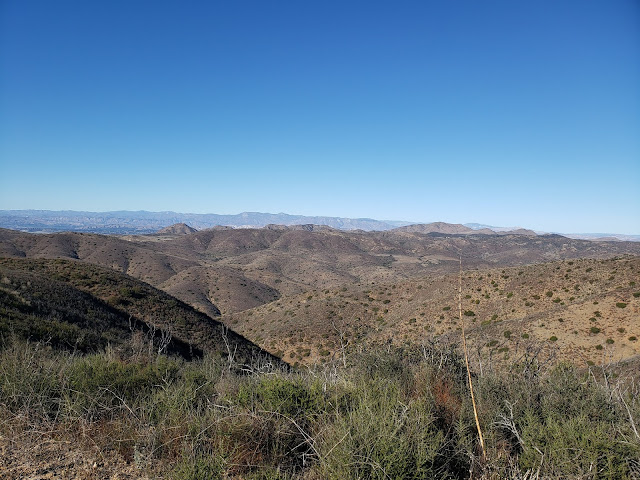
Serrano Valley Santa Monica Mountains

Who needs wilderness? Civilization needs wilderness. The idea of wilderness preservation is one of the fruits of civilization, like Bach's music, Tolstoy's novels, scientific medicine, novocaine, space travel, free love, the double martini, the secret ballot, the home and private property, the public park and public property, freedom of travel, the Bill of Rights, peppermint toothpaste, beaches for nude bathing, the right to own and bear arms, the right to not own and bear arms, and a thousand other good things one could name, some of them trivial, most of them essential, all of them vital to that great, bubbling, disorderly, anarchic, unmanageable diversity of opinion, expression, and ways of living which free men and women love, which is their breath of life, and which the authoritarians of church and state and war and sometimes even art despise and always have despised. And feared.

~Edward Abbey, Freedom and Wilderness, Wilderness and Freedom

To those devoid of imagination, a blank place on a map is a useless waste; to others, the most valuable part.

~Aldo Leopold, A Sand County Almanac and Sketches Here and There

There exists in contemporary American society a school of thought that teaches the pernicious idea that we the people hold title to far too much green and brown land. Too much open space where flora and fauna and freedom and frivolity and fun and fantasy can flourish. Whether in the form of regional parks, state parks, national parks, national forests, national recreation areas, national monuments, state beaches, national shorelines, conservation areas, or designated wilderness, the thinking is that all of this available land, locked up as it is by an overbearing government, is simply being wasted. "Wasted" in this context meaning that the land isn't being fully exploited for financial gain by private industry - loggers, miners, farmers, ranchers, the oil industry, the energy industry, dam builders, home builders, gold course designers, solar power generators, and the like. This idea, which is incessantly peddled by the monied interests, reinforced by their political mouth-pieces, and generally accepted as Gospel truth by an alarming portion of the population, is hard-coded into the American psyche, an artifact of 19th century expansionism and the arrogant notion of "Manifest Destiny." It is particularly prevalent in the West where, fortunately, we still have large tracts of publicly-owned land to argue over.  

But if this never-ending pandemic has shown us anything, it is the utter absurdity of this well-worn and tired idea. Not only do we not have too much public, open space to cavort in, we have far too little of this most-valuable commodity for a stressed population that needs an unconfined place for both therapeutic and not-so-therapeutic activities. Hiking, biking, running, camping, bird-watching, exploring, finding oneself, losing oneself, hunting, fishing, drinking beer, smoking weed, skinny-dipping, fucking. All of this, good and bad, legal and illegal, is part of the palliative of the public-lands prescription. That probably sounds a bit hyperbolic and overly-opinionated. But that's only because it's a bit hyperbolic and overly-opinionated. But it also happens to be absolutely and infallibly true.

Sycamore Canyon

Serrano Canyon Trail

Serrano Canyon Trail

How do I know this you might ask? Well, because I've seen it with my own eyeballs. Repeatedly. At my local trailhead. In the Angeles National Forest. In the Los Padres National Forest. In the Santa Monica Mountains. In the Sierra. And most recently, on a foray into Sycamore Canyon and it's reliably more serene offshoot, Serrano Canyon. 

It was a magnificent winter day for an outing outdoors and my soul was begging for the chance to escape the mundane confines of my suburban yard which, because of the pandemic, has been mowed and trimmed and clipped and edged and mulched and weeded and watered and planted and swept to perfection. Being the stereotypical dad that I am, I like my yard to look presentable. But it's gotten to the point that I now wander my yard aimlessly, clippers at the ready, searching for unruly twigs to snip, errant weeds to yank, and any other landscaping imperfections to remedy. I then retreat to the house for about 30 minutes or so, only to return to the yard again with my clippers just in case some botanical menace has happened to spring up and take hold during my brief absence. 

So on this day, I determined to escape the pathetic prison of domesticity, and my self-imposed, quasi-exile from trailheads beyond my community, and venture out into the world. I would penetrate Serrano Canyon in Pt. Mugu State Park, glory in its glory, search for Red-Legged Frogs in the remnant pools along the now dry creek-bed, frighten myself into imagining that every bird hopping around in the leaf litter was a ferocious mountain lion waiting to pounce, lollygag and luxuriate in the soft winter grass of the Serrano Valley, listen attentively to the ancient silence, and pretend that I was a noble Chumash tribesman on a vision-quest. And I fancied that I would engage in this bit of conceit without really having to see, hear, or share space with many (or any) of my fellow countrymen and women.   

Serrano Canyon Trail

Serrano Valley Santa Monica Mountains

Santa Monica Mountains

But those silly delusions faded into oblivion when I encountered a teeming mass of humanity clogging the coast and filling the folds, crevices, and recesses of the range that immediately fronts the Pacific. It began at at the Chumash Trail trailhead and continued unabated to Sycamore Cove. Thousands of automobiles jammed the roadway as folks desperately searched for a place to stop roadside and disembark. Those that succeeded, sat in their cars, windows down and eyes closed as the sun warmed their faces and the cool, salty breeze washed over them. Others stood at the water's edge, absorbing the blue sky and the bluer ocean whose horizon is punctuated by Anyapax and the three saints. Still others scrambled down to the sand carrying towels and umbrellas and coolers and other beach paraphernalia to find a place next to the roaring and foamy surf. Even the "lesser" beaches, the ones littered with rocks or other ocean-borne detritus, were fully occupied.

Past Thornhill-Broome, cars lined the PCH all the way to Sycamore Cove. At the great sandhill, hordes of kids and adults and seniors crawled up and down the dunes like hungry ants on sugar. At Sycamore Cove, a line of cars was queued-up at the entrance on a fool's errand to get a parking space that did not exist. On the opposite side of the road, a sign at Sycamore Canyon indicated that the lot there was similarly "full." Paradise has never been easily attainable, but on this day, attainment was virtually impossible.

Dejected, I turned around and contemplated just going back home to pout. But on a pass going north, I spied someone pulling out of a legal spot on the other side of the road. Despite high demand, these legal spots along the PCH are in shorter supply these days ever since CalTrans posted "No Parking" sign all up and down the coast. It's a dirty and sinister ploy which foists upon "we the people" the Hobson's Choice between the paid lots or a ticket. Either way, you pay the king's ransom for the privilege of stepping onto your public land. I made a dangerous U-turn and pulled in to the open spot before anyone else could. Fuck the state of California and its sordid and transparent revenue-generating schemes. 

Serrano Canyon Trail

Serrano Canyon Trail

Serrano Canyon Trail

Away from the coast, within the shaded confines of Sycamore Canyon proper, the automobile was replaced by the bicycle. Here, a steady stream of cycling enthusiasts cruised up and down the canyon in groups of two, three, four, and more. Sycamore Canyon has always been an attractive haven for cyclists, but on this day, the bi-pedal traffic was uncharacteristically heavy. A good distance up the valley, I ducked into the wilderness, Serrano Canyon, which is closed to bikes and is too distant for most casual hikers. Here, the traffic by-and-large finally subsided. 

This is no way to run a public-land asylum. Every inch of the public domain everywhere is being lovingly mauled to death by the American public and foreign visitors. There simply isn't enough room for us to all get away from each other. And the problem is not unique to Southern California. Our national parks are literally being overwhelmed with visitation spiking significantly nationwide. It has gotten to the point that we now have lotteries that you must enter and win in order to experience some of our more high-profile and eye-popping places (e.g., Mt. Whitney, the cable route to Half Dome, etc.). These are the types of places that Mark Kenyon has said "physically move you, creating a tightening in the chest, a loss of breath, or a tingling along the spine."

But politicians of a particular persuasion don't want you to believe what your lying eyes are showing you. Instead, they want you to buy off on the notion that we actually have way too much public land, especially wilderness which Senator Mike Lee (R-UT) dismissively refers to as the "royal forest." Invoking the bogeyman of feudalism, Mr. Lee and his adherents attempt to leverage the specter of craft beer-swilling, artisanal coffee-drinking "elites" to encourage the idea that such lands are neither intended for, nor open to the the archetypal everyman. 

I'm not sure that I know what an "elite" looks like, especially on the trail, and I didn't realize that the litmus test for being an "elite" was avoiding Miller Beer and Folgers coffee, but I do know this to be complete and utter bullshit. Putting aside for the moment the fact that only 5% of the land in America is designated as wilderness (2.7% if you exclude Alaska), and 18% of national forest lands are designated wilderness, the folks I have seen and shared the backcountry with have been quite a varied group - young, old, white, black, Hispanic, Asian, conservative, progressive, on horseback, on foot, armed, unarmed, well-equipped, ill-equipped, formally-educated, uneducated, seemingly wealthy, and seemingly less-wealthy. We're all there, bumping into each other and enjoying the outdoors that Mr. Lee fantasizes has been locked-up for use only by the "elites."

Edward Abbey once said "better a cruel truth than a comfortable delusion." So regardless of whatever label you want to pin on the people using the outdoors, here's the cruel truth: there isn't sufficient wild, undeveloped, open space to comfortably support the number of "elites" and "non-elites" who want to enjoy it. And we can't simply create more land out of thin air or whole cloth or whatever idiom you want to use. Another cruel truth. So what we're left with is making certain that we preserve the limited open space that we fortunately still have. Because barring an unimaginable loss of life beyond what we have already experienced due to the pandemic, or a radical reconfiguration of our ideas and attitudes about procreation, we're going to want and need that open, public land for both our physical well-being and our mental health. Because as Henry David Thoreau said, in "wildness is the preservation of the world."

Thursday, November 26, 2020

The Persistence of Piedra Blanca


Piedra Blanca Los Padres National Forest

Until death, it is all life.
~Miguel de Cervantes Saavedra, Don Quixote

No matter where you go, there you are.
~The Adventures of Buckaroo Banzai Across the 8th Dimension

The plan was...well, there was no specific plan really. We would just make it up as we went along. Let things unfold organically. Go with the flow. Ride the wave. Pierre Joseph Proudhon called it "the fecundity of the unexpected." It's an approach that literally makes my more centered half insane. She bristles at the idea of having no destination, no route, no schedule, no agenda. Me, I don't mind so much. In my daily life, I'm chained to planning and schedules and agendas and calendars and deadlines and meetings and formal processes. So cutting free from that rigidity is liberating. And I've found that things generally work out if you let them. 

So off we went into the forest like Don Quixote and Sancho Panza, the aging adventurist with his head full of romantic ideas about the outdoors, and his more pragmatic side-kick. We didn't pack much. This was to be a quick and dirty outing. On the way, we stopped for over-night necessities. Burritos from La Casita in Santa Paula, beer from Transmission Brewing in Ventura. Then up the Maricopa Highway.

I've accepted more crowds in the forests these days. Another inconvenience of the pandemic. But on this day, Route 33 was surprisingly and pleasantly quiet. At Rose Valley Road we veered east and descended to the Piedra Blanca Trailhead. Here too, we found less company than we had expected. A good omen on this All Hallows' Eve. 

On the trail, we crossed Lions and Sespe Creek which both still held water this deep into the dry season. At the junction with the Sespe Creek Trail we had options. Right took us east where we might find a nice spot along the creek. Left took us west and then north toward the impressive white sandstone of Piedra Blanca. Wanting an open site with uncluttered views where we could peer deep into the abyss of the universe on this Blue Moon night, we chose the latter route. Our pace was unhurried as we had committed in advance to not go far and just enjoy a leisurely night out. 

Sespe Creek Los Padres National Forest

Piedra Blanca

At Piedra Blanca, we wandered without agenda up, over, and through the manzanita and white stone until a promising location to put down for the night revealed itself. For those who have ever spent a night in the outdoors with me, this is generally a painful process because of my annoying, idiosyncratic insistence on finding the absolute perfect spot. My propensity to demand campsite flawlessness is so well known by my outdoor companions that it's become a bit of a running joke amongst them. As soon as we get to this part of any trip, the furtive glances and eye-rolling always begins as I scour the surrounding area for a truly transcendent site.   

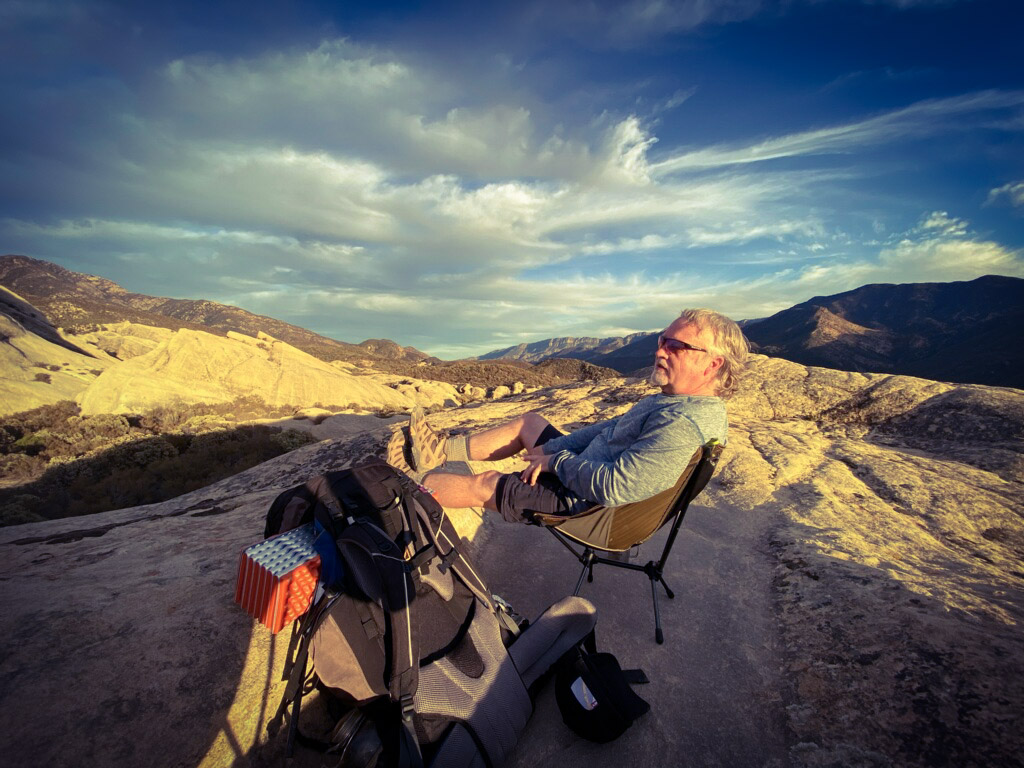
Much to the chagrin of my companion, I was no different on this occasion, but fortunately the search was short. At the top of an impressive sandstone monolith with big sky views, we found a flat depression large enough for two bags and declared this our home for the evening. Because we were  cowboy camping, set up was easy and soon enough we were hard at work on the beers we had brought  and staring at nothing in particular and everything in general.  

Sespe Wilderness

Transmission Brewing

Piedra Blanca


Words are an imperfect medium to communicate the sacred sublimity of this place. True understanding can only be gained by sensing it, feeling it, allowing it to seep into and permeate every fiber of your soul. The indigenous people that previously occupied this land (this is the historical territory of the Ventureno band of the Chumash people) certainly understood this. Or being the overly-romantic character that I am capable of being, so I'd like to imagine.  

As the sun started its descent to the horizon, and dark shadows began creeping across the landscape, we sat in the stillness as the rock turned gold and the sky turned pink. Then, the lights went out completely. And stars twinkled and glinted as diamonds in the infinite black sky. A full moon then rose and it was like daylight once again. And we realized our place in both time and space. Despite what we as a species choose to believe, we're an insignificant pin-prick in the vast, undefinable fabric of the universe; an irrelevant flash along the time-line of infinity. But this immortal place, it has always been and it will always be. That's both a disconcerting and comforting thought. 

Piedra Blanca Camping

Piedra Blanca Sunset

Piedra Blanca Sunset

Piedra Blanca Full Moon

The next morning, the sun returned to brilliance, the sandstone shone white, and the cycle of things began once again. We meandered through the area looking for nothing, exploring like children for its own sake. Then it was time to leave, our welcome worn out, our trespass threatening to become conversion. So we packed up and left to return another time with the knowledge that this immutable place will be there. It always has been and always will be. 

Piedra Blanca Sespe Wilderness

Piedra Blanca Hiking


Monday, November 23, 2020

Ain't No Cure for the Pandemic Blues

Muau Flat Thorn Point
Thorn Point and Mutau Flats

Sometimes I wonder what I'm gonna do
But there ain't no cure for the summertime blues
~Summertime Blues, Eddie Cochran

So I'll meet you at the bottom if there really is one
They always told me when you hit it you'll know it
But I've been falling so long it's like gravity's gone and I'm just floating
~Gravity's Gone, Drive By Truckers

As you can tell from looking at the large gap between posts here, I haven't been inspired to write much lately. The process has always been a laborious challenge for me, but now it's a real struggle to even put pen to paper. Being the opinionated bastard that I am, it's not that I don't have anything to say. Just ask the people around me. They know that I'm rarely at a loss for words. And they're probably grateful for the respite from my constant yammering and bloviating. But the whole thing weighs on me. The muse has abandoned me without notice and everything I try to write now feels forced and inauthentic.

But these are strange and frightening times we're living through. People are fucking dropping dead from an enemy that can't be seen or fought. We're all wearing face-masks at the grocery store for fear of contagion. I haven't shaken a stranger's hand or given someone outside of my bubble a hug in months. I'm maxed out on vacation accrual, but can't go anywhere to use it. The restaurants and malls are empty, but the trails are packed with people, graffiti, and trash. And politicians' promises notwithstanding, it don't look too much like things are going to get materially better for the average person any time soon. So yeah, things are kind of fucked up right now. For that reason, I guess my muse can be forgiven for perhaps having a case of the pandemic blues.

In an effort to get out of my funk, I decided a day in the woods would be good for my soul. So last Friday, I played hooky from work and headed for San Rafael Peak, a seldom-visited summit deep in the Sespe Wilderness. 

The Iron Hiker joined me on this adventure. The original plan, devised by the ferrous one, was to hike Hines Peak and Cream Puff from the eastern terminus of the Nordhoff Ridge fire road. To do that, we needed a permit from the Forest Service. But that plan was foiled when fires closed the entire Los Padres for a spell and permits became unavailable. Then, the normal, seasonal closure of the Nordhoff Ridge road went into effect guaranteeing that we would not be doing Hines Peak the easy way until next spring. So we went searching for a remote, uncrowded, and challenging alternative. San Rafael checked all of those boxes nicely. 

Grade Valley Road
Morning Commute

Cattle Drive

We met early at the entrance to Grade Valley Road and then drove the 10+ miles south on a washboard dirt road to the Johnston Ridge Trailhead. Sunlight peaked through the forest canopy as we went and I kept an eye out for wildlife as the conditions seemed ripe for a sighting or two. Unfortunately, all we encountered was a herd of bovine blocking the road that weren't in any particular hurry to cede ground to us. But being the superior beings that we are, we dispatched the dumb beasts with a couple of blares of the horn and we were on our way. 

The trailhead parking area was vacant. We were the only ones in the forest. We gathered our gear and started off, heading southeast on a well established trail that skirts Mutau Flats to the south as it drops about 200' in elevation to Mutau Creek. The word "Mutau" features prominently in this part of the forest. Although linguistically it sounds like it could be Chumash in derivation, it's actually the last name of a cantankerous old horse rustler who homesteaded these parts. Old Man Mutau, who settled in the area that is now the flats, was a known ally to horse thieves who moved stolen horses along the Horse Thief Trail from southern Ventura County to Kern County. Mutau, whose homestead sat right along the trail, permitted rustlers to use a canyon on his homestead (appropriately named "Horse Thief Canyon") to graze purloined horses before they were moved off to Tehachapi to be sold to work crews who were constructing the railroad from San Francisco to Los Angeles. Old Man Mutau met his maker at the flats that now bear his name when was ultimately shot and killed there.

Little Mutau Creek Trail
No Country for Old Men

Mutau Creek Sespe Wilderness
Mutau Creek

Little Mutau Creek Trail
Breathing Room

Mutau Flat
Moo-tau

Mutau Creek was still flowing some, so we splashed through and started up a minor drainage that climbed to an obvious saddle at 5,729'. Along the way, we found a mylar balloon with a bright pink boa that we would retrieve on our way out. (PSA: stop releasing mylar balloons into the air people!) At the saddle, the trail continues east, dropping into the Little Mutau Creek drainage. Here, however, we abandoned the trail, opting to go cross-county in a southerly direction over a serious of bumps that lead to San Rafael Peak. 

The Sierra Club says that the navigation along this part of the route is "difficult," but we found it to be pretty straight-forward. At one stage, we wandered slightly off-track, going too low on the northeast flank of Pt. 6,408, but we quickly righted ourselves by making a steep climb back to the ridgeline which has expansive views of Hot Springs Canyon and the Sespe Creek drainage. We then traversed one final minor bump and made the steep climb to the summit. 


San Rafael Peak Route
Going Off the Grid

San Rafael Peak Route
Dragon's Back

San Rafael Peak
St. Raphael

Hot Springs Canyon
Home of Hot Springs

Atop San Rafael we had 360-degree views of the entire Ventura County backcountry. Cobblestone, Topa Topa, Devil's Heart, Hines, Chief, Thorn Point, Haddock, Reyes, and Pinos are all clearly visible from summit. We logged our appearance in the summit register which dated back to 1974 and then lollygagged in the warm sun and tried not to share our snacks with a bunch of insistent hornets that magically appeared every time a plastic baggie or foil was opened.  

Then it was time to go. Days are short this time of year and light a precious commodity. We were well equipped with lighting, but really didn't want to have to rely upon it. So we retraced our steps back to the trailhead and began the long drive back to the reality of life in a pandemic. I can't say that this little adventure cured my pandemic blues or broke my writer's block, but as the old saying goes, "sometimes you just need to go off the grid and get your soul right." And my soul was right on this day. 

Cobblestone Mountain
Cobblestone Views

Devil's Heart Peak
Topa Topa and Devil's Heart

Summit Pano

Thorn Point
Thorn Point, Haddock and Reyes

San Rafael Peak Route
Going Back Home