Sunday, June 11, 2023

In Search of Black Jack


In 1887, Owen and Jason Brown, the sons of famed abolitionist John Brown, climbed an unnamed peak in the front country of the San Gabriel Mountains which they christened Black Jack Peak. The appellation simultaneously referenced the black porphyritic rock of which the peak was composed as well as the 1856 Battle of Black Jack during which John Brown attacked the camp of pro-slavery forces led by Henry C. Pate near Baldwin City, Kansas. The Battle of Black Jack is considered by many to be the first unofficial battle of the Civil War. 

Historian Hiram Reid described Black Jack Peak as a "spur" from Strawberry Peak with a sharp, distinct pinnacle that is composed of "black spar." Beyond that general description, he does not identify the specific peak to which reference is being made.


The Hundred Peaks Section of the Sierra Club claims that nearby Mt. Lawlor is Black Jack. According to them, what is now known as Mt. Lawlor was originally named Black Jack, but the name never stuck because of its negative associations with John Brown's bloody Kansas raid. So in 1958, the U.S. Forest Service, at the suggestion of Lloyd Austin of Switzer's Camp, renamed the peak Mt. Lawlor to honor prominent Los Angeles attorney Oscar Lawlor. 


The problem with the Sierra Club's conclusion that Lawlor and Black Jack are one and the same is that aside from the black rock, the former doesn't match Hiram Reid's description. Lawlor has a flat, table-top summit whereas Black Jack has a "distinct pinnacle of its own, very steep, rugged and sharp." Depending upon vantage point, it's also somewhat of a stretch to call Lawlor a mere "spur" of Strawberry. Regardless, the Sierra Club view (which echoes that of famed historian John Robinson) has managed to carry the day and is now the commonly-accepted truth.

Unless you're an adventurous and intellectually-curious fellow named Sean "Cucamonga Man" Green. If you're that guy, you're suspicious. You've scoured the topographic maps and looked through the historical record (such as it is) and you think that John Robinson and the Sierra Club may have gotten it wrong. Instead, you think it possible the sub-peak 5,521 on the south face of Strawberry is in actuality Black Jack. Unlike Lawlor, it can rightfully be characterized as a spur of Strawberry given its location and proximity. It also more closely hues to Reid's description of the peak as a sharp pinnacle, especially if viewed from the Colby Canyon side. The only question is whether 5,521 is composed of black, porphyritic rock. So you organize an exploratory outing to 5,521 to find out and invite a bunch of your old pals to tag along.

We met at Red Box at 6:00 a.m. and started up the Strawberry Peak trail. The group of seven was led by Sean, and included Nate, JeffH, the Iron Hiker, Guy, and Scoops (who sported a bow-tie around his neck in a nod to the hardy hikers of old who trod these trails in wool sport coats and top hats). We followed the Strawberry Peak Trail past the Lawlor saddle to roughly the 5,400' contour where we then left the beaten path and started cross country.  

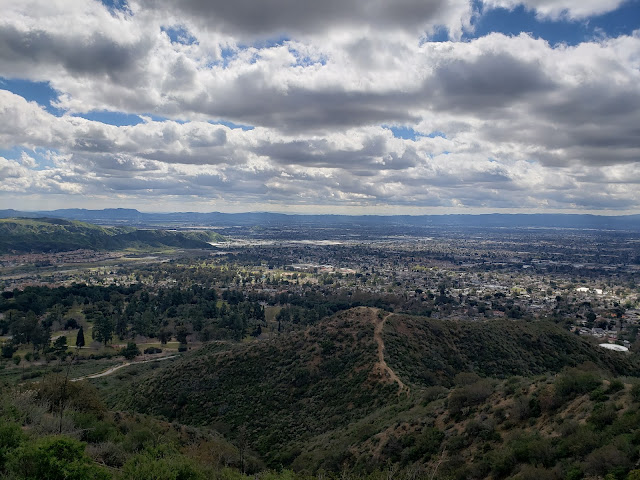
Peak 5521 from Strawberry Peak Trail

Bush Whacking

Black Jack Peak

This is where things got a bit spicey. There is no path proper to peak 5,521. Between us and our objective stood a sea of thorny ceanothus, woody manzanita, deadfall from the 2009 Station Fire, and other spikey shrubbery. This is tough and inhospitable country, a place John Muir appropriately described as "most ruggedly, thornily savage." The only way forward was to create a way forward. So we donned body armor, pulled out the loppers and machetes, and started hacking and clawing our way through the dense overgrowth. As the crow flies, it was only about one-half mile to the summit of 5,521, but the going was slow and sometime painful as we stumbled and were repeatedly stabbed by chaparral yucca that proliferate here. 

Ultimately we reached a minor spur ridge beneath Strawberry where the brush subsided and the way forward became a bit easier. We gratefully sheathed the machetes and then followed some faint game trails all the way to the narrow summit. There Nate informed us that perhaps one-third of the rock was porphyritic, but most of it wasn't overtly black. The views, however, were quite good, especially of Strawberry that loomed over us to the immediate north. 

So is 5,521 the peak the Brown boys named Black Jack? It still isn't clear. The peak matches Hiram Reid's description in many respects, but it is clearly not "composed entirely of a porphyritic rock called 'black spar.'" But Lawlor isn't a perfect match either. Although its level summit does have a significant amount of black rock, it typically wouldn't be described as a sharp pinnacle. Confirmation therefore must await further research and/or new information.

Josephine Peak from Black Jack Ridge

Strawberry Peak's South Face

View from Black Jack Peak

Despite the residual uncertainly, we christened 5,521 "Black Jack Peak" anyway. If it is the original Black Jack, then its rightful name has been restored. If it isn't the original Black Jack, then it is Black Jack now. Sean came prepared with a jar and register that we all signed and left on the summit for other intrepid explorers. Meanwhile, the path the we hacked through the thick brush is already being reclaimed by mother nature and will shortly be lost to time like much of the history of Black Jack. 

Thursday, March 16, 2023

Snow Day L.A.

Pt. 4,003 - Fernando 2

With luck, it might even snow for us.

~Haruki Murakami, After Dark
 
The snow doesn’t give a soft white damn whom it touches.
~e e Cummings

Folks around these parts are fond of saying that L.A. is a desert. It’s a misconception that gets perpetuated through the inertia of perpetuation. Although the climate here is generally warm and dry, Los Angeles is more accurately characterized as a coastal sage and chaparral environment with a Mediterranean climate. In practical terms, that normally means hot, dry summers, and cool, rainy winters. But regardless of whether L.A. can be accurately described as a desert or by some other descriptor, the one constant is that snow in the local hills is a rarity. I’m not talking about the high country peaks of the San Gabriels like Baldy, Ontario, Cucamonga, and Baden-Powell. Those summits frequently see some level of snow every winter. I’m talking about the low elevation, front-country peaks like Rocky Peak, Oat Mountain, Mission Peak, Los Pinetos, Mendenhall, Sister Elsie, and the Verdugos. Although they may get an occasional dusting, significant snow accumulation on these afterthought peaks is quite unusual. 

We’re only two-plus months in, and 2023 has turned out to be an anomaly, at least as far as the weather is concerned. Back in the fall, when the hillsides were scorched brown and the skies were barren, the weather gods were predicting a triple-dip La Niña. In common-speak, that meant a third year of below-average rainfall and continuing drought for thirsty Southern California. As often happens when it comes to the meteorological sciences, however, all that prognosticating was just that: prognostication. The triple-dip never really materialized. Instead, since early January, California has been pummeled by a series of “atmospheric rivers” (the new vernacular for what was once known as the “pineapple express”) that have blanketed the Sierra in an unfathomable amount of snow and showered the state with record rainfall. 

Low-lying areas have not been spared nature’s climatological wrath. A flurry of recent storms left snow falling in the San Fernando Valley, the Inland Empire, and the hills above Ventura and Santa Barbara. It even snowed at the Unhappiest Place on Earth. We’re not talking hail or graupel or whatever glorified else that typically gets hyped for the white stuff when it “snows” in Southern California. This was the real deal. Fluffy white snow that fell from the sky like manna from Heaven and then stuck.

The day after one of these recent storms, I figured I needed to get out for a romp in the hills. It had been raining for days and I was beginning to feel caged. The plan, to the extent I had one, was to make my way to the Santa Monica range where I figured the trails would be more passable. As I was filling my gas tank, however, I glanced east and could see snow capping the Santa Susanas. Right then and there, I decided to abandon my prior plans and make my way into the San Fernando Valley instead. I didn’t really have an identifiable objective yet. I’d figure that out as I went. I just knew that this was a once-in-a-lifetime opportunity that I would later regret passing up if I didn’t take advantage of it.

As I rode the 118 east I could see that the entire range encircling the Valley was blanketed white. In the distance, San Gabriel, Markham, Lowe, and Wilson were all covered. I really wasn’t outfitted for snow – shorts, a base-layer, a light mid-layer, and a hiking stick - so I figured it best to avoid these higher elevations where temps were likely to be low and the snow deep. Mission Peak was a possibility but it struck me as somewhat dull. I could see that Los Pinetos and May Peaks both had some coverage so I made my way to Veteran’s Park in Sylmar where I figured I could get to the snow by way of May Canyon Road (3N54).

Someone once told me that the hike out of Veteran’s Park was the North Valley’s equivalent of Runyon Canyon. Other than the absence fit, beautiful people in tight neon garments, I found that to be a fairly accurate description. As I started up the paved fire road, I was joined by throngs of folks making the same pilgrimage that I was making. And most of them looked to be as ill-prepared for the foul weather as me. 

The walk up May Canyon Road to the saddle at the crest is a 5 mile road walk on deteriorating asphalt that sees almost 2,000 feet of gain. As hikes go, it isn’t terribly exciting even though the surrounding terrain is quite nice and the view exceptional. Fortunately or unfortunately depending upon your perspective, there is a more direct alternative. Just beyond where the road leaves Veteran’s Park, a steep firebreak follows a ridgeline north all the way to May Peak. Strangely, the vast majority of folks on the trail this day took this more challenging route even though it appeared to be a significant physical  struggle for most of them. As I climbed the very steep break, I was joined by dog-walkers, young children in Sketchers, little old abuelas, macho guys in smooth-soled engineer boots, and large, extended families. The most direct and challenging route did not discriminate against hikers on the basis of sex, age, race, ethnicity, sexual preference, fecundity, experience, preparedness, or ability. 
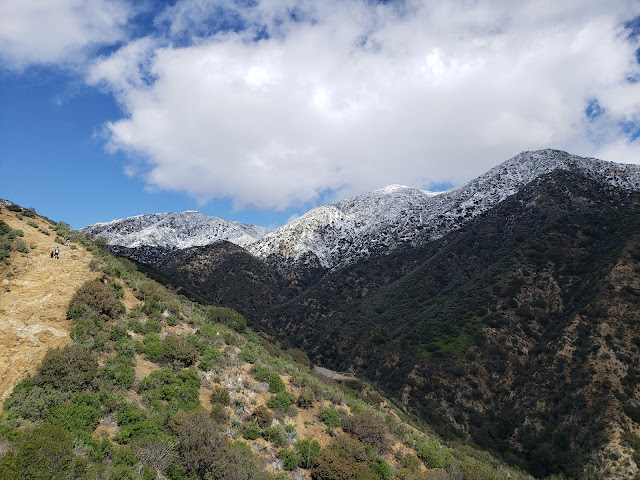
Lower May Canyon Ridge Route

May Canyon Ridge

Santa Clara Ridge with Snow

A short distance up, the ridge crossed May Canyon Road at a nice vista point. A good portion of the crowd dropped off here. I crossed the road and continued along the ridge route that is comprised of a series of very sharp climbs interrupted by short level sections. As I continued upward, patches of slush began to dot the ground making the path wet and sloppy. That slush then became a thin sheet of snow that covered the ground. 

At the base of a steep section of the ridge, I contemplated how much farther I should go. I was in shorts, didn’t have spikes, and really wasn’t prepared for serious winter travel. But from this vantage point, it felt as if I this was the last climb before the route finally topped out. I could see that a few other hearty souls had made their way up before me, so I determined to carry on despite the fact that the slope angle was high and the footing questionable.  

At the crest of the climb where things leveled off a bit, I discovered that my figuring was all wrong. Ahead, the firebreak continued up yet another steep climb. And the depth of the snow on the ground had increased to about 10-12.” Going forward would involve plowing through this shin-deep snow in shorts. Going back would require a sketchy descent down a steep, slick slope. Deciding that hypothermia was probably better than serious injury, I continued upward, making sure to step in the virgin snow along the edges instead walking the slippery footsteps of those that came before me.   

When I reached the top, I finally found myself at the top which was adorned with a shredded American flag fluttering in the icy wind. The pure white landscape was ethereal and surreal and aesthetic. I sat down briefly on a bare rock to absorb both the unique scene and the can of beer stowed in my pack, but found sitting idle to be uncomfortably cold. So I threw on the only additional warmth I had and picked my way through the knee-deep snow and driving wind to the May Canyon Saddle where 3N54 tops out and intersects with Santa Clara Road (3N17.0).

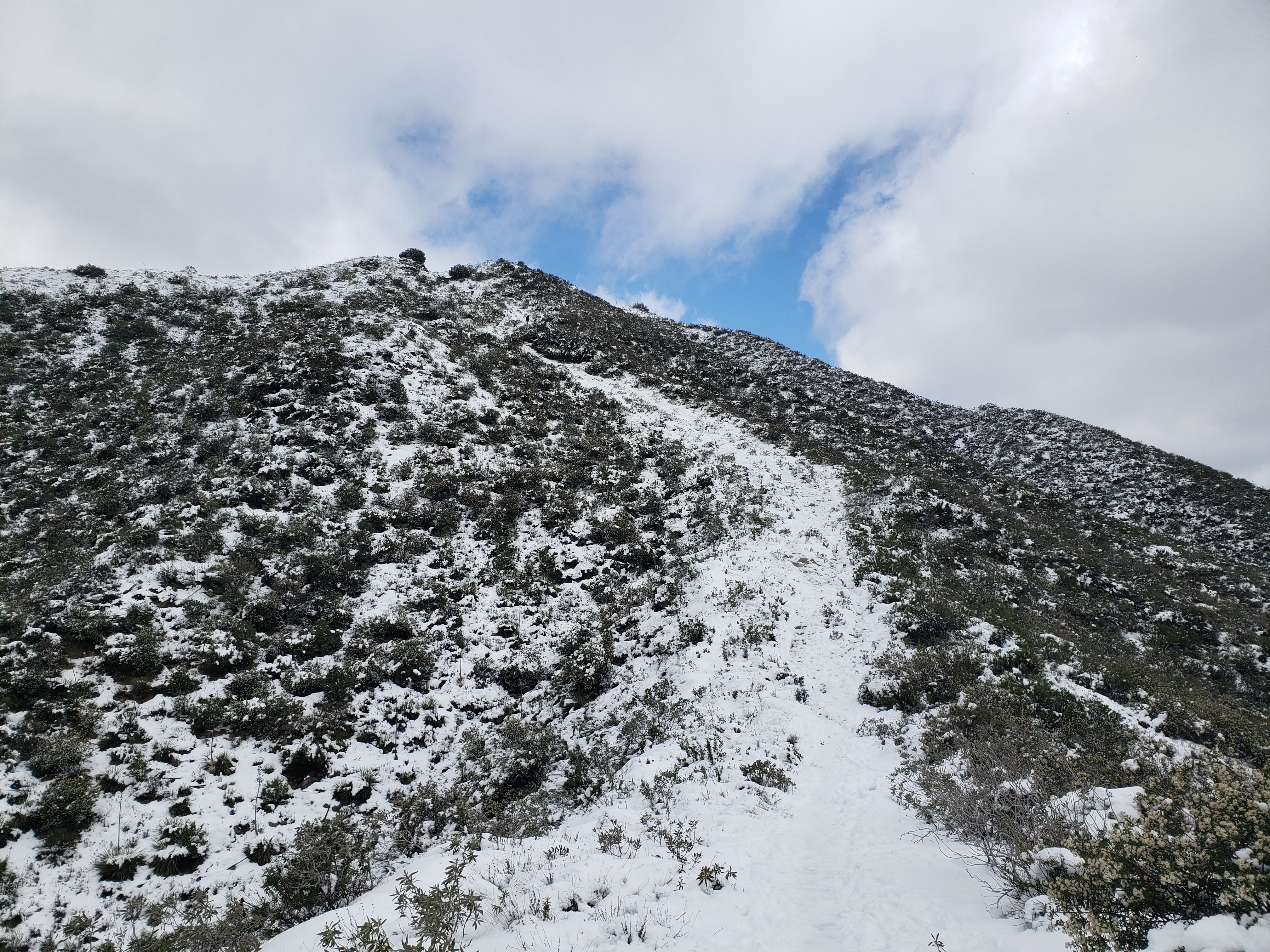
Upper May Canyon Firebreak with snow

May Canyon Ridge Flagpole

View East from May Peak

I again momentarily thought about stopping at the saddle for a snack and a drink, but by this point, my feet were wet and my fingers numb. I needed to get off the breezy ridgeline and gain warmth by losing some elevation. Since returning the way I came wasn’t a realistic option given my state of ill-preparedness, that left a 5 mile walk down slushy May Canyon Road. 

Somewhat surprisingly, the snow clung to the ground quite tenaciously as I descended. I found that escaping it, even on this south-facing slope, took longer than I expected. It wasn’t until I reached roughly the 3,000’ contour that the road was finally snow-free and things began to warm up some. At that stage, I pulled the can of Sierra Nevada Celebration Ale that I had brought out of my pack and walked along with my open container predictably provoking the side-eye from a number of people that I passed. 

After what seemed an interminable amount of time, I was back at the vista point where the ridge route first crosses the road. Here, I retraced my steps down the steep fire break to Veteran’s Park. As is typically the case, the descent on tired legs and old knees was much more difficult than the climb up. That reality reinforced for me that the decision I had made earlier in the day to continue up the ridge when I first encountered snow was the correct one. 

Anyway, it was a rare and beautiful snow day in Los Angeles. Regardless of how you choose to describe the climate and ecosystem here, the snow this season has brought us is anything but ordinary for this glitzy, mid-latitude metropolis that folks are fond of calling a desert.

May Canyon Fire Road (3N54)

North San Fernando Valley from May Canyon Fire Road


Wednesday, February 15, 2023

The Pursuit of Awe


Just beyond the creek crossing, the Old Cabin Trail folds back onto itself like a protein molecule and begins climbing out of the cool green of Upper Sycamore Canyon. It’s a gorgeous winter morning so the trail is crowded, but the overwhelming majority of the hikers don’t make this hairpin turn. They don’t have much interest in what’s up the hill. They’re only here for the ephemeral waterfall that feeds the creek. A curiosity in this hyper-arid landscape to be certain. I’ve seen it myself. So the conga line continues in a straight trajectory toward the base of the falls just up canyon. I make the hard right and start ascending. Immediately the hordes fall away and I’m alone on the trail. As I prefer. 

I realize that might sound anti-social. I’m also aware of the potential danger of a solitary outing. I’m following in the footsteps of 22 year-old Zachary Zernick whose story is fresh on my mind. Zachary walked this exact same trail the week prior and never returned home. Search and Rescue found his body at the base of cliff where he is believed to have accidentally fallen to his death. It’s obviously sad and tragic that this kid was struck down before his life really even began. But I’d like to believe that Zachary knew and understood the risks of going it alone before he ever went out. Hopefully I’m not wrong about that, but most folks who have spent any appreciable amount of time hiking solo do. That doesn’t mean they have a death wish. Or that they are presumptively negligent. They simply accept, even if society doesn’t, that inherent risk of death or injury is the price of admission for a bit of solitude.

The trail is wonderfully damp and cool as I climb. A slight coastal breeze blows up canyon. That is not the typical experience. This is sharp and inhospitable country. For a good portion of the year, these hillsides are a tangle of thorny, skeletal chaparral. When the heat is up, the plant life here falls into a quiet dormancy. Leaves curl up, flower petals wither, and seeds drop to the ground in anticipation of the wet season to hopefully come. Muted olive, sandstone, slate, and rust, the favored palette of homeowners' associations everywhere, predominate. But when the winter months arrive with rain, the landscape transforms into something very different. The thirsty flora suddenly explodes in what John Muir called a “shaggy exuberance.” Soft green California Sage and its aromatic Black cousin spring to life. Orangey California poppies start popping. Chaparral Bush Mallow blooms a gorgeous pink and peach. Giant Coresopsis, which looks like a meth-addled minx ten months out of the year, unexpectedly becomes a beautiful and seductive temptress. It’s a super-bloom of visual and olfactory magnificence.

I pass a few pairs of hikers on their way down and nod to them as we file past each other. I do this instinctively and robotically because they’re just background noise. I see them, I am aware of their presence, but I filter them out. I’m too mesmerized by my natural surroundings to be concerned with social engagement and pleasantries. I have that every day. I’m here for escape from that. And escape I shall. 

A short distance further, the trail levels out and splits. The left branch descends to the old Danielson cabin site and memorial. The right fork continues to climb to the junction with the Old Boney Trail. Most folks that come this way turn left. I tack right and keep climbing through tunnels of California lilac that are humming with ravenous hornets and honey bees. I’ve arrived at a détente of sorts with these buzzing arthropods. I don’t interfere with their day-drinking of nectar and they don’t sting the shit out of me. It’s a fair accommodation that works reasonably well for both of us. One day, I hope to arrive at a similar understanding with ticks.


A half mile later, I hit the crest just below Pt. 1,918 where the path levels briefly. A short use trail here puts you on the high-point before continuing as the Western Ridge Trail to the summit of Tri-Peaks. The news reports don’t say, but my suspicion is that this was Zachary Zernik’s chosen path. I’ve been to Pt. 1,918 several times previously so don’t feel compelled to do it again. Instead, I commit to explore the Old Boney Trail as it descends the southern flanks of Sycamore Canyon.

The climbing is done for now and as I continue west, I begin to give back some of the elevation I just gained. That means the walking is easy here and I’m able to move quickly as I descend to the junction with the Fossil Trail. Along the way, I get really nice looks at Sycamore Canyon, Mugu Peak, and the Oxnard Plain. I even get a peek-a-boo view of the Channel Islands. I pass a couple along this stretch and catch another, older couple where the Old Boney and the Fossil Trails intersect.

By its evocative name, the Fossil Trail sounds like a compelling and exciting romp. One immediately imagines coming upon the fossilized remains of all sorts of prehistoric creatures large and small. The reality is something significantly more mundane. The namesake fossils comprise a handful of shells embedded in a short rocky section in the middle of the trail. It’s cool. It’s just not spectacular by any measure. The promise is over-sold. 

I’ve never been beyond this point on the Old Boney Trail so ask the couple whether they are familiar with what lies ahead. They eye me suspiciously, grunt that they are taking the Fossil Trail, and then turn away to filter me out. I suppose I deserve it. They’re apparently not here for social engagement and pleasantries either. 

So I take the plunge and continue west to see what there is to see. The “plunge” metaphor here is appropriate in that the trail is somewhat overgrown and I find myself pushing through a bit of brush. This stretch of Old Boney clearly doesn’t see the same traffic as other sections of the trail and the native flora is taking advantage. But the brush begins to cede ground again when the trail tops out on a low ridge that begins a mellow descent to the Backbone Trail. From this point forward, it’s a pleasant downhill stroll.

Now the land feels wild and remote. I can no longer see Sycamore Canyon. It isn’t that far away, but it’s out of view, behind a larger ridge to the north. It may as well be a million miles away. To the immediate south is the sandstone escarpment of Boney Mountain and the Tri Peaks. And I’m alone on the trail. The only sound is the crunch of my feet on the path. There is no other noise to filter. Silence and solitude sit heavy on the landscape.

So does the thrum. That enigmatic and palpable trembling of the universe that rings in your ears and vibrates your soul. A subtle reminder that ultimate reality is very different than you imagine. I can’t hear the hum today, but I can feel it. Lurking beneath the silence in quivering anticipation. I embrace the rhythm and allow my personal waves to align with those around me. In the world of physics, they call that constructive interference and it results in wave amplification. I ride the amplified waves all the way to the junction with the Backbone Trail where California Poppies are starting to bloom. It’s such a stunningly beautiful sight that I prostrate myself on the trail for a bug’s compound-eye view.  


It hasn’t rained for weeks, but remarkably the water is still flowing down the unnamed drainage leading to the Danielson Group Camp. In all the years I’ve walked these hills, I never recall seeing conditions like this. But as I continue down the canyon, the reason becomes evident. The placid little stream that is currently making things so enjoyable must have been an angry torrent just weeks prior. The bottomlands are clogged with flood debris and large swaths of the trail have been obliterated. Route-finding isn’t terribly difficult, but I suspect it will be some time before he trail proper is restored to its former self.

At Danielson I sit at one of the many empty picnic tables to gear up for the long walk up the ribbon of asphalt that is colloquially known as the Black Bitch. A boisterous flock of feral Nanday Parakeets keeps me company. It sounds exotic I know. And it is if you’re using the term “exotic” as a pejorative. These bright-green birds don’t belong here. They’re invaders who have escaped captivity and are now procreating with the zeal of fecund Catholic couples who believe that birth control is sinful. As a result, these pretty birds from the interior jungles of South America are a noisy thing in the Mediterranean environment of the Santa Monica Mountains. 

I’m back with people as I begin my walk out. The thrum has gone mute. Or maybe it has just been forcibly drowned out by the white noise of hikers, bikers, and the occasional park ranger pick-up truck. Either way, no amount of filtering can change that dynamic. I accept that. Even welcome it. Because if the quivering of the universe was commonplace, it would be neither mysterious nor magical. Solitary treks to seldomly-visited places in search of it wouldn’t be so lustrous. I’m a selfish bastard that wants to hold onto that. So here, in the designated white noise zone, I’m quite accepting of the heterogeneous mixture of chatter, commotion, and hubbub. As long as the contagion doesn’t spread to become a white noise pandemic that murders the élan vitale, I can still trod these trails in the pursuit of awe.