Wednesday, January 5, 2022

Fire Canyon Wash


Fire Canyon Wash

In the first place, you can't see anything from a car; you've got to get out of the goddamned contraption and walk, better yet crawl, on hands and knees, over the sandstone and through the thornbush and cactus. When traces of blood begin to mark your trail, you'll begin to see something, maybe. ~Cactus Ed 

As you drive north on I-15 out of Las Vegas, you pass through the Moapa Valley, a broad and arid expanse of high desert populated by screwbean mesquite and creosote. From the windshield of a speeding automobile, it presents as a hot, desolate and rather uninviting place. Which of course is why the United States government forcefully relocated the Moapa Bank of Paiutes here in 1869. At first blush, it was the shittiest and least useful land we could find to "give" to them as a reservation. But the U.S. government has a history of taking back what it gives to the natives. So although the land originally assigned to the Paiutes consisted of the entire Moapa River watershed (including lands along the Colorado River), in 1875 that allotment was reduced to a paltry 1,000 acres. Today, the reservation stands at approximately 75,000 acres in total, but given the government's abysmal record on taking back from the natives what they have given, it is more than ironic that the offensive appellation "Indian-giver" somehow inexplicably became associated with the supposed dishonesty and treachery of natives as opposed to the white man.

I've driven this stretch of road innumerable times on my way to Utah. I've seen the sign for the colorfully-named Valley of Fire which conjures up images of an inhospitable Dantean hellscape, but I had never once exited the freeway to take journey to the Inferno. Embarrassingly, the closest I ever came was when I exited the freeway once to patronize the Moapa Paiute Travel Plaza for fire water and explosives.

But on a recent trip across the desert, I had the luxury of a few extra hours, so I decided to see what I was missing. At the appropriate exit, I got off the freeway and started south-east across the desert following the winding 2-lane ribbon of asphalt approximately 15 miles to the park entrance. There, I tried without success to convince the attendant that I was a Nevada resident and thus entitled to a discounted entry fee, but he was shrewd and wasn't having any of it. So I coughed up the obligatory $15 charge and proceeded into the park. 

Fire Canyon Wash

Fire Canyon Wash

Fire Canyon Wash

Knowing that my time was limited, I had done a bit of research in advance and had targeted the Petroglyph Canyon Trail leading to the Mouse Tank. Although it's quite a short trail, on its face it appeared to provide maximum bang for both the dollar and hour. Beyond that, looking at Google Earth I discerned that it might be possible to continue down Fire Canyon Wash at the terminus of the trail proper for additional off-trail scampering and exploration. So that was my aim.    

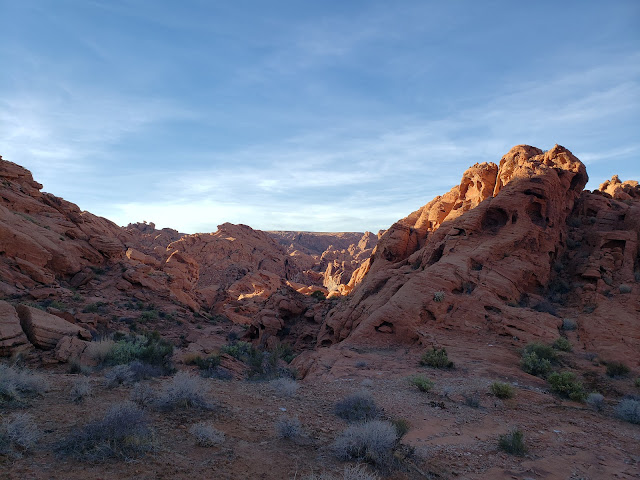
There was a fair number of cars at the trailhead as I started off down upper Fire Canyon Wash and into the maze of redrock fins, spires, pinnacles, hoodoos, hobgoblins, and other fanciful formations. But the path itself fortunately wasn't as crowded as I thought it might be, so I strode along in reverent awe of both the landscape and the various petroglyphs scratched into the black patina on the adjacent sandstone walls by the ancient Basket maker and Anasazi people who inhabited this place some 2000 years prior.  

A short distance later, the trail abruptly terminated at the Mouse Tank (or more accurately, at a precipice looking down onto the Mouse Tank). "Mouse" (or more appropriately, "Little Mouse") was apparently the name of a renegade Southern Paiute who used the Valley of Fire as a hideout in the late 1800s. The "Tank" is a natural basin where precious water collects after the rains. Thus, the Mouse Tank.

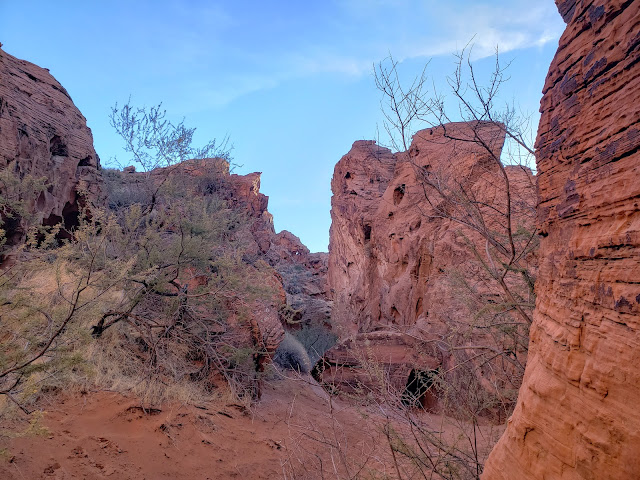
Not willing to end my exploration so early, I scampered up a rocky bypass to the left and then dropped down into the Mouse Tank. I then continued down canyon following the sandy stream bed further into the bowels of fantastic Fire Canyon Wash. Initially, the wash was broad and the going easy. But as I penetrated further into the canyon, the path narrowed, the walls closed in, and the going got considerably more interesting. Here I found myself scampering around, crawling over, straddling, and ducking under large sandstone blocks that clogged the drainage and impeded the path forward. It was both fun and challenging and I was enjoying the serenity of the gorge which I had to myself. Ultimately, however, I reached a blockade that choked off further access to the drainage without a bit of down-climbing. It was potentially a point of no return. Being solo, and uncertain whether I could climb back out if I committed, I reluctantly decided to become a SAR statistic another day and retraced my steps back up canyon. 

On my initial descent, I noticed another drainage entering from the right as I came down canyon. I still had time and daylight, so on my way out, I decided to explore this drainage as well. This ended up being less of a gorge and more of a shallow valley with a dry creek bed running up its center. I followed a faint use or game trail for awhile until I topped out at a flat saddle. To the east, there was an endless jumble of more sandstone. To the north and south the same. An endless playground for rock-hopping and off-trail scrambling. This was no country for old men.

Coming back down the valley I could see in the distance exactly where I needed to end up, but navigation in the redrock desert is tricky because everything looks the same. So ultimately I found myself in a slot of sorts that I knew was unfamiliar. Obviously on the descent, I'd failed to pay close enough attention to what I was doing and had veered off track. This is both the thrill and peril of desert hiking. It's very easy to get disoriented and lose your way. And when the temperatures are scorching, such an error can easily prove fatal. 

Recognizing what I'd done, I doubled-back to the point where I zigged when I should have zagged, and then returned to the Mouse Tank wiser but without incident.
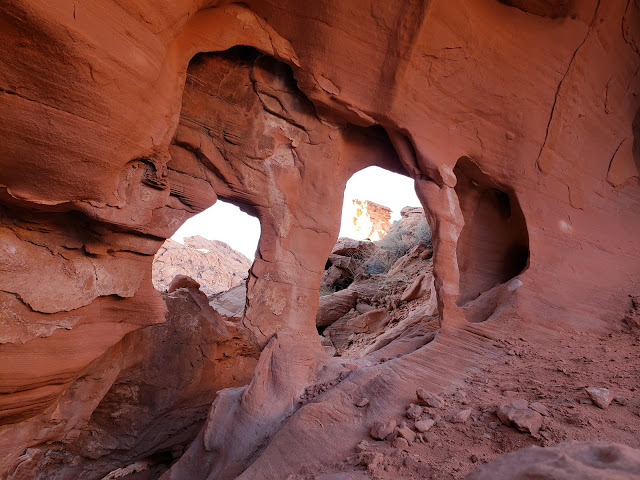
Fire Canyon Wash

Sandstone Windows

Fire Canyon Wash

Back on the established trail, I noticed another side drainage with a sort of use trail entering again from the right (or the left if you are returning to the trailhead). Figuring I might as well leverage my limited time in the park as much as possible, I tacked hard left. Initially, the drainage was a flat and sandy walk. But a short distance in, I hit a crag where the path continued up a crack that split the rocky monolith. The climb up wasn't terribly challenging although it did add nice variety to the outing. And when I topped out, I was rewarded with more outstanding looks at the surrounding area.

It was now late afternoon, the shadows were creeping across the landscape, and the air was getting noticeably cooler. Time to leave.  But on my way out, the Valley of Fire gave me one last gift. Just outside the park entrance, the handful of cars in front of me all came to a sudden stop. For a moment, I thought perhaps there had been an accident of some sort. But then I saw what all the commotion was about. A solitary desert big horn sheep was foraging immediately roadside, unfazed by the crowd of gawking onlookers. As I pulled along side to snap a picture out the passenger-side window, the sheep glanced at my without any apparent interest and then continued crunching away on the local grasses. 

Back at the I-15, I pulled into the Moapa Travel Plaza thinking I'd pick up a nice six-pack of craft beer before crossing into the land of Zion where the selection is limited and the prices are high on account of "sin" taxes. I have heard Mormons jokingly refer to this governmental levy of additional taxes on the "Gentiles" (anyone who is not a Mormon and therefore, in theory, doesn't drink) as "bleeding the Beast." Ha, ha. Yeah, totally hilarious. All those drinkers and smokers subsidizing the Utah educational system for the benefit of all the hyper-fecund Mormon couples. Bleeding the beast indeed.

Anyway, I was surprised and dismayed to find that the Travel Plaza had a pretty uninspiring selection of beer to choose from. Coors, Miller, Budweiser - mostly just shitty, mass-produced American lager in gigantic quantities. Pass. I drank that swill growing up as a young apostate in Utah and I wasn't going there again. So I continued up the road to Mesquite where I stopped at Lee's Discount Liquor instead for my weekend supply of adult malt and grain beverages.  

Having got a sample of what the Valley of Fire has to offer, I'm now all hot to return on my next pass through Moapa for further exploration. Although it's a relatively small park, there's still quite a bit of territory left unexplored. 

Valley of Fire Petroglyphs

Desert Big Horn Sheep - Valley of Fire


Sunday, December 5, 2021

Crescenta View Trail

Crescenta View Trail

 Tip the world over on its side, and everything loose will land in Los Angeles.
~Frank Lloyd Wright

L.A. is the loneliest and most brutal of American cities.
~Jack Kerouac

The final story, the final chapter of western man, I believe, lies in Los Angeles.
~Phil Ochs

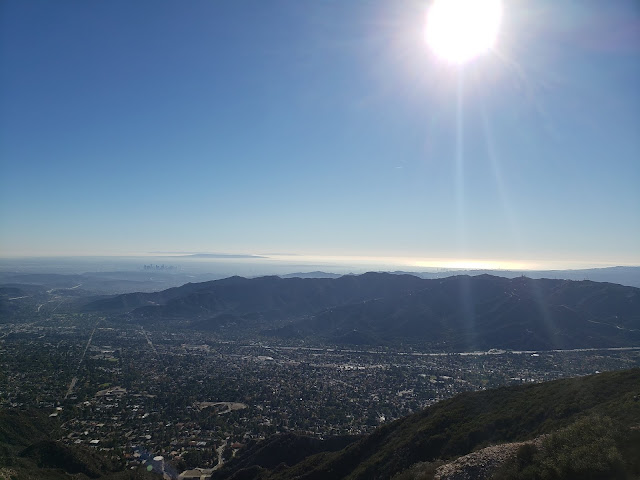
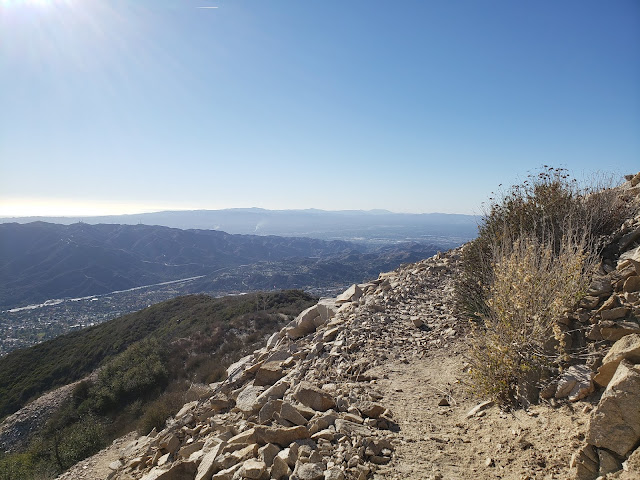
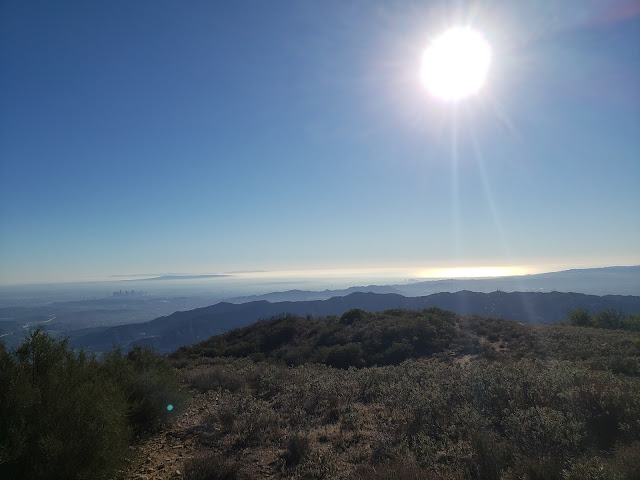
Roman Polanski once said "Los Angeles is the most beautiful city in the world, as long as its seen at night and from a distance." Obviously, Mr. Polanski never hiked the Crescenta View Trail on crystal clear, sunny day in November. If he had, he would have known that viewed from on high and afar, with the island-studded, gleaming Pacific as a backdrop, the City of Angels is a spectacular, if not messy, sight to behold.

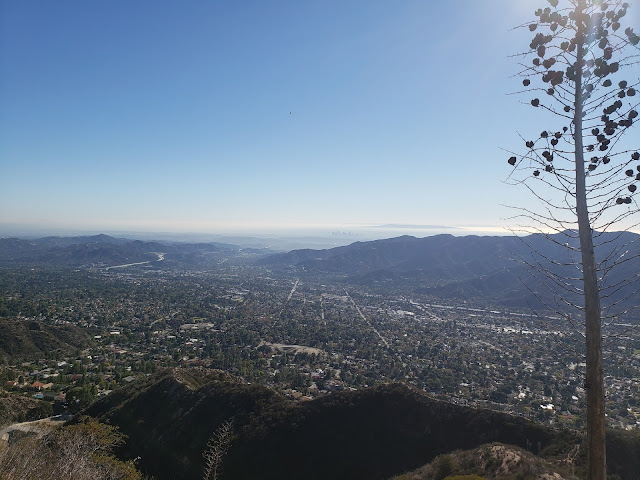
How do I know this you ask? Because I recently hiked the Crescenta View Trail on a crystal-clear, sunny day in November. And from a perch at 4,400' feet, Los Angeles, in all its frenetic, sprawling, chaotic glory is quite a beautiful thing. This despite what all those sneering east coast elites and raffish midwestern outsiders might say otherwise.

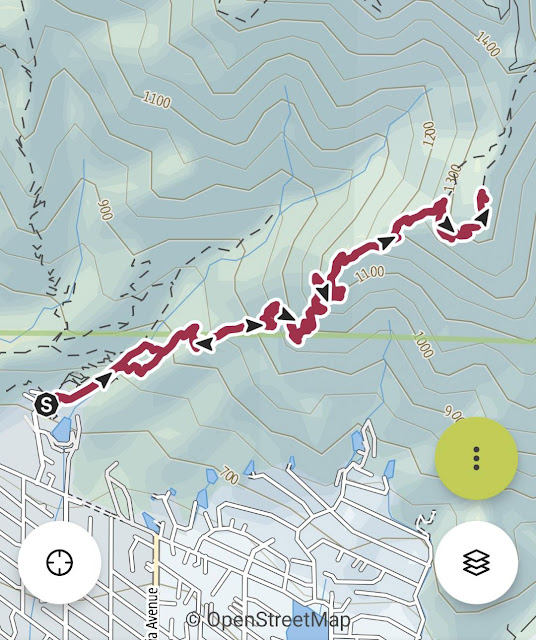
The Crescenta View Trail starts at Deukmejian Regional Park which is technically in Glendale. As far as trailheads go, Deukmejian is somewhat unique in that it has plentiful free parking, water, and full bathroom facilities. Bueno! The track begins at the rear of the parking area and gently ascends Dunsmore Canyon adjacent to the dry creek bed. A short distance up-canyon, a trail branches off to the right and crosses over to the east side of Dunsmore Creek before continuing northward. A similar connector intersects the Dunsmore Canyon Trail further up the canyon. Wanting to get off the more heavily-traveled main trail, I took the first branch which was a mistake as the path has been completely washed away where it crosses to creek. I had to scramble up a steep and brushy bank on the other side to regain the trail. I did not repeat that mistake on the return trip, following the second connector further up canyon.   

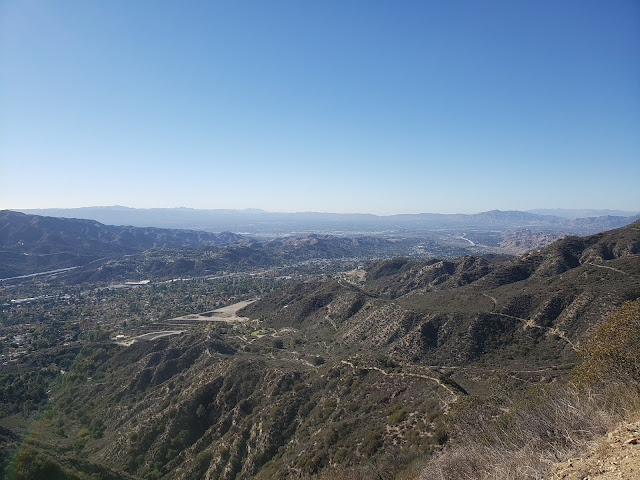
A short distance later, the climbing begins as the path switch-backs up the ridge that separates Shields and Dunsmore Canyons. The climbing isn't particularly steep, but it is sustained and really doesn't let off until you reach the saddle where the Crescenta View Trail ultimately intersects the Mt. Lukens fireroad. From that point, you can traverse the dirt road a short distance west to the summit of Mt. Lukens, the highest point in the Los Angeles proper at 5,074 feet.

There is apparently some controversy over the name "Mt. Lukens." According to the Sierra Club HPS Section, the peak was previously named "Sister Else (or Elsie) peak. Nobody seems to remember or know who the original female namesake was, but as part of the 1875 Wheeler Survey, a chap named "McLain" decided "Lukens" was a more appropriate appellation and so renamed the peak in honor of Theodore Lukens, a former Supervisor of the Angeles National Forest. McLain ostensibly did this because "mountains should be monuments to the men who have treasured and protected them," gratuitously observing "what did Sister Elsie ever do for the mountains?" 

Crescenta View Trail

Crescenta View Trail

Crescenta View Trail

Anyway, my objective this day was not the summit of Sister Else Peak. Instead, my plan was to simply hike to the Redoubt, a circular rock enclosure on one of the ridge's promontories accessorized with a flagpole. There, I figured I'd take in the views, have a snack, lollygag a bit, and then return to the parking lot. But as alluring as that might sound, the Redoubt is an exposed and shadeless place, and sitting there baking in the direct sunlight for any appreciable amount of time is not ideal. So I continued another 3/4 mile up the trail to the Pickens Spur water tank which is also a shadeless and exposed spot, although perceptibly cooler. Plus, the flat concrete there affords an opportunity to lounge about without having to roll around in the dust and dirt.

From this spot high on the ridgeline, the entire Los Angeles basin is observable. Downtown, midtown, Century City, Santa Monica, the Palos Verde Peninsula, the Valley, and the Verdugos are spread out before you like a crazy metropolitan quilt. To the distant east, you also get impressive looks at all the celebrities of the San Gabriel front country: Mt. Deception, San Gabriel Peak, Occidental Peak, Mt. Markham, Mt. Wilson, Mt. Lowe, and Brown Mountain. 

Pickens Spur water tank
  

Crescenta View Trail

Crescenta View Trail

I stripped my sweaty shirt off here, exposing my embarrassing corpulence to no one, and lingered for a while. Shortly after that, things got amazingly hazy so I packed up and started back down the way I came.

Stone Amazingly Hazy IPA

Total mileage for this one came in at 5.20 with an elevation gain of just shy of 3,000 feet.      

Crescenta View Trail

Crescenta View Trail Elevation Profile


Saturday, November 27, 2021

Looping Through the Ventura River Preserve


Ventura River Preserve

The core of mans' spirit comes from new experiences.
~Christopher McCandless (aka Alexander Supertramp)

Old age should burn and rave at close of day.
~Dylan Thomas, Do Not go Gentle into that Good Night

Preliminaries - Old Man Walking

The other day I was stopped at a red light in my suburban neighborhood. As I was waiting for the light to change, a silver-haired gentlemen walking a fluffy white pooch passed in front of me in the cross-walk. It wasn't exactly an unusual site. I see it regularly and usually give it no mind. The sidewalks where I live are alive both morning and afternoon with 50 and 60-somethings in relaxed-fit trousers sedately walking lap dogs and carrying little plastic bags of poo. I guess it's all part of the normal and expected progression of things. Go to college, get a job, have kids, achieve some sort of professional success, bid farewell to your kids as they fledge from the nest, buy a cute little Shih Tzu or Yorkie or Maltese or Chihuahua to fill the void, and then start sauntering around the neighborhood with your canine companion as you slide toward retirement and a more dormant existence.

Unfortunately, I've now joined this baggy pants-wearing, dog-walking demographic. Or, perhaps it would be more accurate to say that I've been "conscripted" into this army-of-the-aged. Because I'm certainly not itching to voluntarily join this club any time soon. It feels like giving up. A death sentence that involves rusting away at the kitchen table with a crossword puzzle in front of you while staring at the world through a double-pane of glass. Or, as old Captain Bildad did in Moby Dick as he piloted the Pequod out of Nantucket and into the open Atlantic as it embarked on a multi-year journey in quest of the white whale, forlornly lingering about the deck and delaying good-byes before reluctantly returning to the tranquility, safety, and boredom of the harbor. Fuck that. I don't want to feel Captain Bildad's sad tug of desire and twinge of regret. I watched my father and father-in-law voluntarily relinquish their passion to the quiet life and it murdered their spirits. 

That is to say that I don't plan to give up so easily. When I go down, I'm gonna go down swinging. Or, to put it in less hyperbolic terms, I plan to hike trails, bag peaks, swim icy mountain lakes, and sleep on a mat beneath the glittering heavens until the laws of the physical world tell me that I can no longer do that. That doesn't necessarily mean that every outing will or even has to be an epic, white-knuckled, risk-filled adventure. At 58, I recognize my limitations. So for me, it involves simply exploring as many outdoor places as I am able in the time I have.
  

The Ventura River Preserve

To that end, last weekend, I decided to check out the trails of the Ventura River Preserve. The Preserve, which is owned and managed by the Ojai Valley Land Conversancy ("OVLC"), sits on land adjacent to the Ventura River that was once part of the historic Rancho El Nido. Seemingly like every other big parcel of undeveloped property worth saving in Southern California, the Preserve was once slated to be developed as an exclusive community and golf course for the well-heeled until it was rescued from that abhorrent fate by OVLC in the late 90s.

Now, Rancho El Nido is a place for outdoor enthusiasts instead of wealthy duffers wearing loud pants and berets. And for the hiker, there is a variety of short and medium-length options to choose from. I had read recommendations to ascend Willis Canyon and then return by way of Rice Canyon for the views the latter affords. But I wanted something longer so decided to loop counter-clockwise through the Preserve on a route that allowed me to see as much of it as possible in one big swoop. 

Rice Canyon

Rice Canyon

Rice Canyon

The Loop

There are three trailheads for the Preserve - the Old Baldwin Trailhead, the Riverview Trailhead, and the Oso Trailhead. I started at the latter midday and began my way up Rice Canyon. Almost immediately, I scared up three deer that bounded off into the brushy hillside at my approach. Although it was late November, it was warm. Sitting in the low foothills of the kiln that is the Ojai Valley, these are hot trails. But in the inner sanctum of the canyon where oak and sycamore proliferate, there was shade. And there was a surprising amount of lush green. The hibernating plant life in drought-stricken California yearns for moisture, and with the recent rains we received has exploded in a lusty and joyous celebration of renewed life. When, if ever again, we get normal winter precipitation, I can imagine these canyons transforming into a verdant Shangri-La. 

I had originally planned to take the Kennedy Ridge Trail as a detour before rejoining Rice further up canyon. But the bottom-lands were so pleasant and inviting, I just stayed the course. Ultimately, the path (really an old ranch road) climbs to a saddle before loosing elevation again as it descends to El Nido Meadow, which I think is a bit of a misnomer. It's not really a "meadow" in the traditional sense of the word, or at least it didn't look like one to me. But whatever you want to call El Nido, it is shady, beautiful and inviting, and I lingered here a bit before starting the stout climb westward toward the Preserve high point. 

At the top of the climb, the path levels out as you make a semi-circle to the junction with the Oso Ridge Trail. Along this stretch, I noticed Hummingbird Sage (Salvia spathacea) growing on the cool north-facing slopes in great proliferation. Later on, I would see the same thing along the Fern Grotto Trail and in the bowels of Willis Canyon. In all my years trodding the trails, I never recall seeing such an orgy of Hummingbird Sage. It must be a stunning site when it is all in bloom.

Willis Canyon

White Ledge Peak

Lake Casitas


At the Preserve high point, you get expansive looks at Rancho Matilija and Lake Casitas to the south and the Ojai Valley to the east. The trail then follows the undulations of the Oso Ridge downward to the junction with the Allan Jacobs Trail named for none other than Allan Jacobs. Here, the path tacks north as it gently zig-zags back up to the Chaparral Crest Trail before returning once again to the floor of Willis Canyon by way of the leafy Fern Grotto Trail. You close the loop by following verdant Willis Canyon to its mouth, and then returning to the trailhead following the flat Orange Grove Trail north along the river.

Back at the car, I decided to return home by way of idyllic upper Ojai Valley instead of the citified 101 corridor. On my way in a few hours earlier, everyone who fled to Santa Barbara from Los Angeles for the weekend was already returning south, snarling traffic through Ventura and The Nard. I had no interest in being a part of that. Bad juju for the soul. Plus, taking the alternate route provided the perfect excuse to stop at The Summit for a Pineapple Coconut milkshake. I don't know if The Summit makes the world's best milkshakes, but it sure seems that way after spending a couple of hours wandering the hills. 

Ojai Valley

Fern Grotto Trai

The Summit Drive In


Total mileage for this loop was 8 miles with an elevation gain of 1,538 feet.

Ventura River Preserve Loop Route

Ventura River Preserve Elevation Profile